Showing posts with label Japanese weave. Show all posts

February 4, 2014

Staggered Corduroy with Japanese Overlay Bracelet


Yep, that's a mouthful for a name!  "Staggered Corduroy" is the under structure, or backside, of the bracelet; "Japanese Overlay" refers to the large and small rings combination on the top side of the bracelet, which pale blue fresh water pearls are set in.  So it's really 2 weaves in one!


Don't let the terms backside, topside fool you; they're both beautiful on its own.  Even when done without the beads, the pattern is already mesmerizing!  But setting the pearls softens the chainmaille edginess, adds an undeniable flair.


For closure, I selected one of my original design of hand forged heart shaped S hooks in anodized niobium in blue-green color fade.


As a first go around on this intricate design, I'm pretty happy with the result!  Lots of potentials!!  Very exciting!!!


Complete views of this lovely experiment available in my Picasa web album.

Credits
~~~~~~~~~
Thanks to Anne E. Mitchell for creating this beautiful design!

November 17, 2013

Another Squarish-Looking Hanging Thingy


Yes, that's the little brother of my first Japanese 8 in 2 Captive 1 (J8in2C1) in blue fade.

This time, I used anodized aluminum (AA) rings with bright aluminum (BA) as captives.  Same general specs as last one, but the aspect ratios (AR's) are slightly different.

Several things to keep in mind when switching materials:

1.  The wire diameter (WD) can vary from vendor to vendor, even from batch to batch depending on when the rings were acquired.

2.  The WD of AA can be very, very different depending on the colors; yes, even from the same vendor, the same batch; this happens to even the best vendors.  My guess is it has to do with the anodizing process of aluminum, how much of the material is eaten away in order for the different pigments to enter and adhere to the voids in the metal.

3.  Well, this one you maillers out there all know already, the inside diameter (ID) changes greatly from metal to metal; the harder temper ones have greater spring back, giving bigger ID, therefore, bigger AR; and this really throws up the overall structures!!

4.  At the beginning of these shapes, the captive rings tend to pop out when I'm not looking.  Felt like I was constantly running after that escaped ring for both of these projects...  I'd imagine it may help by adding a piece of thin gauge wire to temporarily hold the first few squares together, kind of like using a piece of wire to start those pesky Half Persian weaves.


5.  At last, but not least, the whole square will get tighter and tighter as you go.  Much like many other chainmaille sculptures, the last few rings can make the toughest guys cry....  Well, not me!!  I cheated a little by slightly folding the square to make the last few connections, sort of like "folding the space", ya know;-)  Hee hee, does this sound geeky?  But you get what I mean:-)


Any how, the results are very satisfying!  I think I'll make a few more of these, maybe one in each color!

Yay!!!

...

April 30, 2013

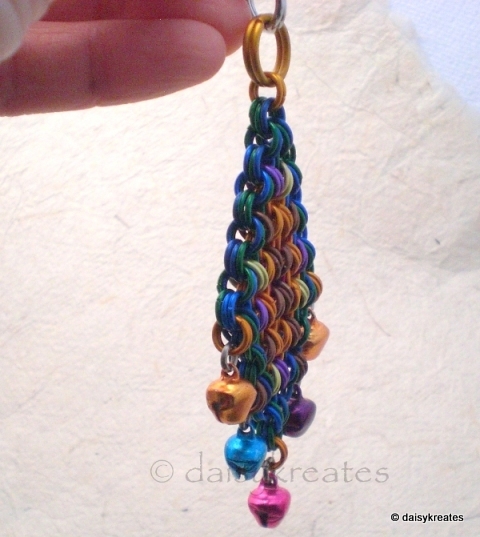
Hishigata (Japanese Diamond) Key Fob

Hishigata (means diamond in Japanese) is a colorful key fob, made in the Japanese chainmaille weave on the loose end of AR, resulting in a fun diamond pattern that is not only pleasing to the eye, also flexible in form to fit comfortably in your palm.


The jingly bells help you find it just in case it fell off toward the bottom of your purse, back pack, shopping bag, and what not:-)


The key fob is made with anodized aluminum jump rings which are light weight, and in brightly jewel tones.  I triple-stacked the horizontal rings to give the diamond shape more substance and better secured to take on the pulls-and-tugs.


I paired the diamond shape with a crescent shape split ring to hold all your key-holding needs:-)  The juxtaposition of sharp corners of a diamond and the soft curve of the new moon!  Unexpectingly complementary!


The key fob measures about 5 inches long, 2 inches wide, 3/8 inch thick.  All color rings are anodized aluminum, with the split/key ring in plated base metal.


For more views of the key fob, please visit my Picasa web album.